

You open a real estate crowdfunding opportunity. The page shows a rate, a term and photographs of the project. Further down is the key investment information sheet. This is where you should look for the connection between the commercial presentation and the rights, costs and risks you would take on.
This guide explains how to read that document, usually called the KIIS, or FIFI in Portuguese. It focuses on offers covered by Regulation (EU) 2020/1503, using property finance examples. It is neither a Dolux offer document nor a substitute for the documentation of a specific transaction.
Short answer
The sheet should help you answer three questions: who receives your money, which rights you acquire and what could prevent the expected outcome. Read the payment schedule, costs and exit conditions too. A prominently displayed rate does not answer those questions.
Keep a copy with the date you accessed it and check that it matches the current offer and version. If the sheet, marketing page and contracts describe different terms, ask for clarification before deciding.
An available information sheet does not mean that a supervisor has approved the project. Crowdfunding investments can involve partial or total capital loss and illiquidity.
What is the KIIS, and when should you receive it?
It contains essential information about a crowdfunding offer. Article 23 of Regulation (EU) 2020/1503 provides for a sheet drawn up by the project owner and supplied to prospective investors by the service provider.
ESMA clarifies that it must be available on the platform when the offer is published and provided before the investor is bound. It is not documentation to discover only after investing.
The rule is a standalone document on a durable medium, separate from marketing, covering no more than six sides of A4 paper when printed. The legislation provides for certain annexes, so counting pages alone is not enough to assess compliance. This article is a reading guide, not the official sheet template.
The regime also distinguishes the sheet for an individual offer from the platform-level sheet used for individual portfolio management of loans. Here we examine a specific offer selected by the investor.
Who prepares it, checks it and bears responsibility?
These are different roles. The project owner prepares the sheet. The service provider must apply adequate procedures to verify its completeness, correctness and clarity. Article 23 also requires identification of the people responsible and establishes rules governing responsibility for the information.
A statement that the data comes from the project owner therefore does not remove the provider's verification duties. It does not mean either party guarantees repayment, either.
The mandatory disclaimer explains that the offer has not been verified or approved by the competent authorities or ESMA. Distinguish the authorisation of a service provider from approval of a project or a return: these are different questions.
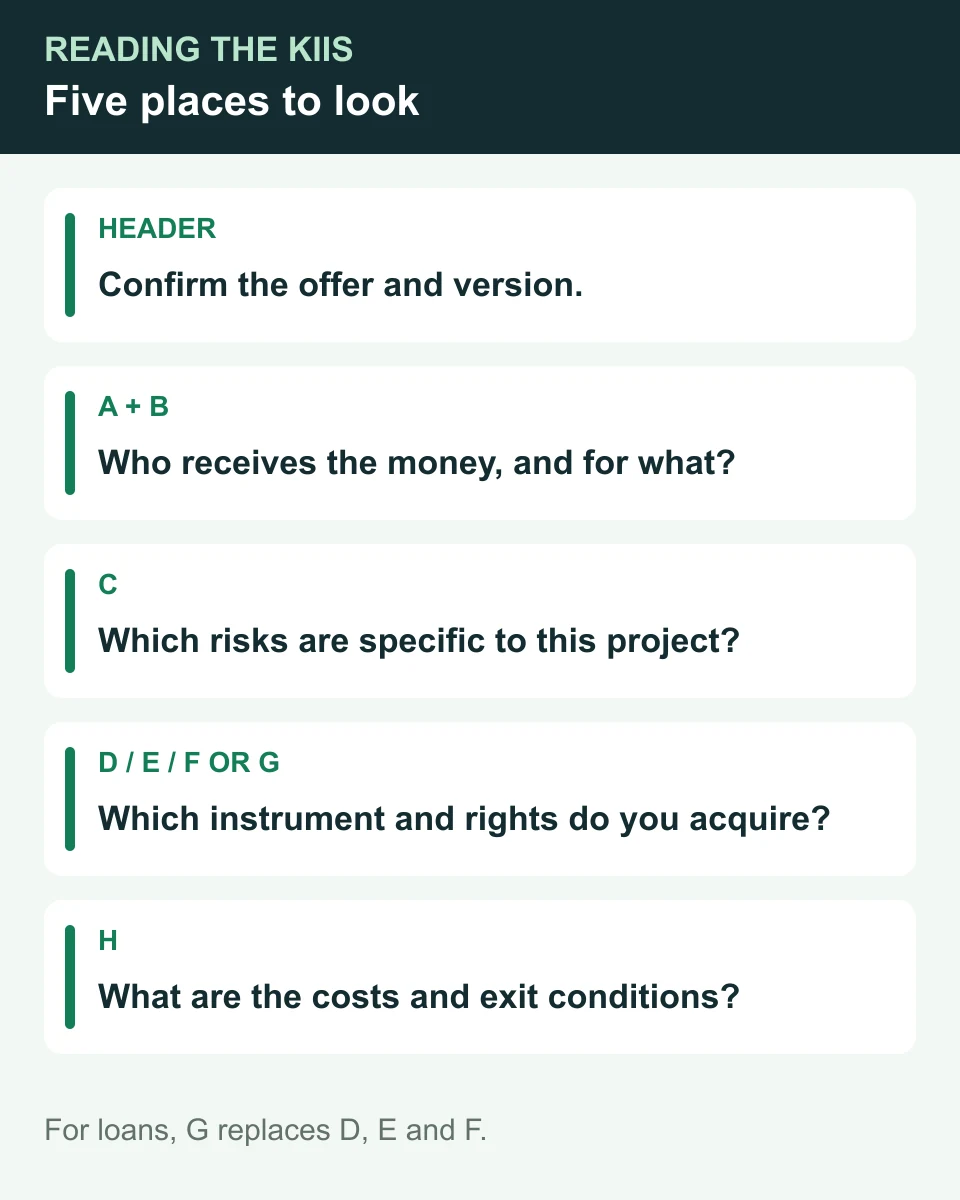
How to read the sheet, section by section
The template in Delegated Regulation (EU) 2022/2119 organises the information into sections. Use them as a map, while checking which apply to the instrument offered.
Start with the header: is this the correct offer?
Check the offer identifier, the provider's name and the date or version supplied. The regulation requires a unique identifier that remains unchanged across translations and updates. The same identifier does not prove that two copies contain the same information.
Compare your downloaded copy with the version available when you make the decision. Where several tranches or instruments relate to the same property, do not assume their conditions are identical.
Part A: who receives the funding, and what is it for?
Find the project owner, its activities, ownership structure, financial information and project description. For property projects, distinguish the trading name, the company developing the project and the entity you will contract with.
Ask where the money needed to fulfil the transaction will come from: rent, property sales, refinancing or another identified source. A projected sale is not a completed sale. Historical company accounts are not a guarantee of the new project's outcome.
Where the document mentions a company established for the transaction, clarify the investor's rights over that company and the property. The guide to fractional real estate investment helps distinguish access to an investment from direct ownership.
Part B: what funding is being raised?
Check the target amount, offer deadline, consequences of not reaching the target and relevant fundraising conditions. Do not confuse three numbers: the project's total budget, the funding sought through this offer and your own investment.
Understand how the offer fits into the entire financing structure. If the project depends on the developer's own funds or another loan, ask for clarity on the amounts and their status: planned, committed or already provided.
The campaign's closing date is not necessarily the interest start date, construction completion date or repayment date. Label each date by what it actually represents.
Part C: are the risks specific to this project?
Article 6 of the delegated regulation requires risk descriptions relevant to the particular offer. A paragraph merely stating that all investments involve risk does not explain what could go wrong in this transaction.
For a property project, look for information that helps assess permits, construction, costs, demand, concentration and reliance on future financing, where relevant. The useful question is: which event could prevent payment or exit, and what response is planned?
The existence of security does not settle the analysis. Confirm who provides it, which obligation it covers, its limits and the conditions for using it. Do not turn a property valuation into a recovery promise.
Parts D, E and F, or Part G: which instrument will you acquire?
Parts D, E and F address, as applicable, securities or admitted instruments, special purpose vehicles and investor rights. They cover matters such as conditions, transfer restrictions and exit opportunities.
Where an offer involves the facilitation of loans, Part G replaces the information in Parts D, E and F. An inapplicable section is not automatically an omission. First identify the instrument correctly.
For a loan, read its nature, duration and terms, remuneration and calculation method, principal and interest schedule, security, and who services the loan, including after a default. Check the conditions of any early repayment too.
Receiving interest monthly does not mean receiving principal monthly. A scheduled repayment date is also different from a right to sell your participation whenever you wish.
If you acquire equity, identify economic and voting rights, priority relative to other holders and transfer conditions. Do not read an expectation of capital growth as a commitment to pay interest.
Part H: what do you pay, and where can you ask questions?
Look for direct and indirect costs borne by the investor, exit conditions, access to further information and the complaints process. Distinguish a cost you bear directly from a transaction cost that may affect the result available for distribution.
The official template requires amounts and percentages in the cost table to be calculated for a hypothetical €10,000 investment and on an annual basis. This is a presentation reference: it does not, by itself, set a €10,000 minimum investment.
Also read the nature of each charge: one-off, ongoing or event-driven. Presenting costs on an annual basis does not make every charge a fee payable each year.
A worked example: why you should not divide every cost by ten
Imagine that a sheet shows a €100 cost for a reference investment of €10,000. In that example, the cost is 1% of the capital. You want to know how much you would pay on a €1,000 investment.
- If it is proportional, at 1%: €1,000 × 1% = €10.
- If it is a fixed €100 per investor: you still pay €100, equal to 10% of €1,000.
Both models can produce the same number in the €10,000 example, yet have different effects on a smaller investment. Minimum charges, tiers or specific conditions may also apply. Only the fee terms let you calculate the correct amount.
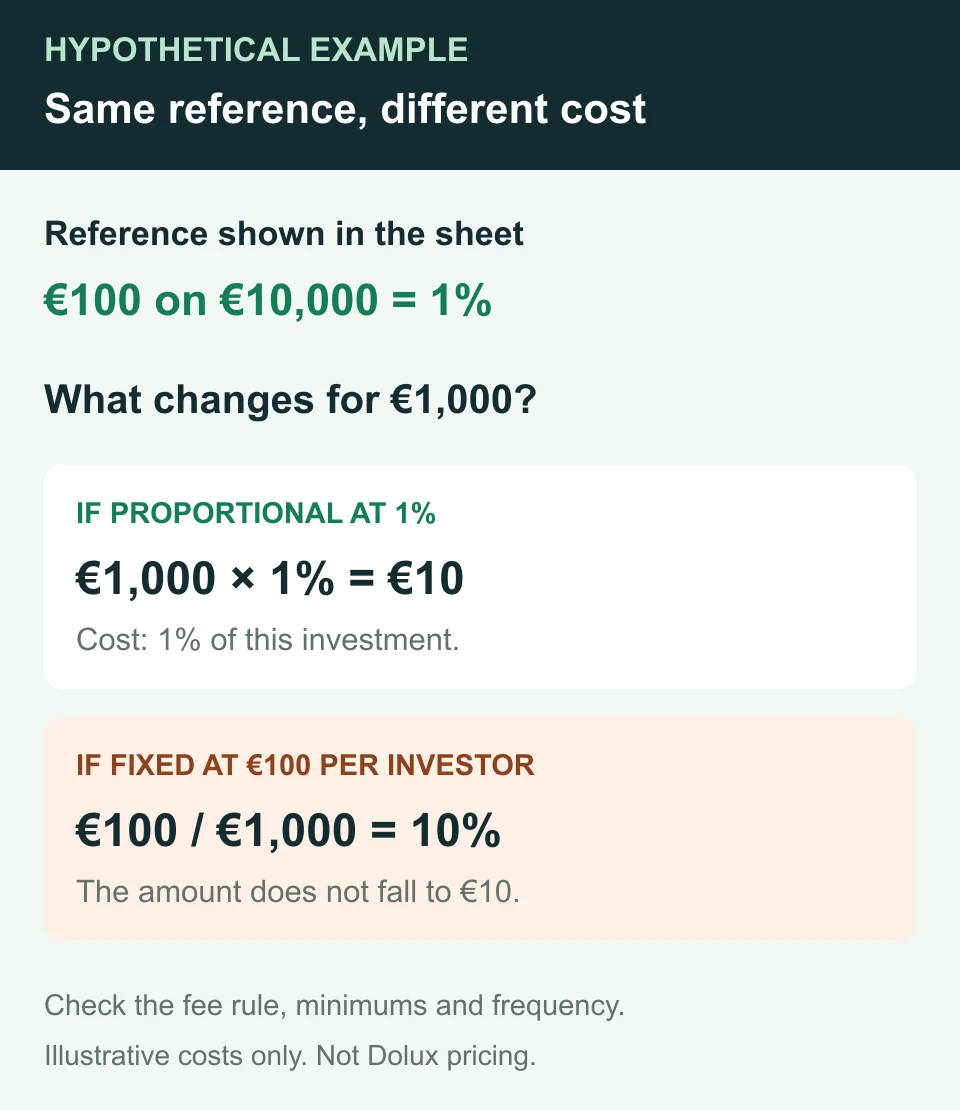
These are educational assumptions, not Dolux pricing or typical market charges. They compare only the identified cost; they do not calculate returns, taxes or the full costs of an offer.
How Dolux makes money describes the planned business model. To assess a specific transaction, always check its documentation and applicable pricing rather than extrapolating from a general explanation.
What if information is missing or versions disagree?
Identify the relevant field and ask a question that can be checked: “The page says 12 months and the sheet says 18 months. Which term applies, and where is it documented?” Keep the answer and corrected version.
Do not assume every typo immediately cancels an offer. Article 23 provides a specific process for omissions, mistakes or inaccuracies that could materially affect the expected return, including correction, suspension in certain circumstances and cancellation if the irregularities are not resolved within the prescribed period. For your decision, establish the correct terms and current offer status.
An oral answer or a marketing message should not be used to disregard an unresolved documentary inconsistency. If rights, costs or security remain ambiguous, independent legal advice may be needed.
Does the sheet remain current after the offer closes?
Article 23 requires updates throughout the offer and immediate communication of notified material changes to investors who have made an investment offer or expressed interest.
After closing, do not assume the original sheet describes the project's current position. In a 2025 answer about sale advertisements on a platform bulletin board, ESMA acknowledges that the sheet may have become outdated and highlights the importance of identifying when it was supplied to the seller.
If you are considering a later purchase of a participation, request current information about payments, arrears, security and transfer conditions. A sale advertisement does not guarantee liquidity or automatically update the original offer documents.
Before confirming: six questions to take away
- Who is my counterparty, and what is the instrument? Can I identify the entity and the rights I acquire?
- What does this offer finance? Can I distinguish the campaign from the budget and the project's remaining financing?
- When and how might I receive money? Can I distinguish interest, principal, duration, exit terms and associated risks?
- Which costs apply to my amount? Have I checked fixed charges, percentages, minimums and frequency?
- Which documents do I hold? Have I saved the sheet, contracts, relevant annexes, access date and clarifications?
- What remains unexplained? Can I identify specific uncertainties instead of relying only on the advertised rate?
Understanding the offer is one part of the decision. Assessing whether you can bear losses and illiquidity is another. The guide to starting to invest from scratch covers that preparation.
You can read how Dolux works and follow the project through the waitlist. This educational content does not announce an available offer or attribute a regulatory status to Dolux.
Frequently asked questions about the KIIS
Are FIFI and KIIS the same document?
In this context, they are names used for the key investment information sheet under the European crowdfunding regime. Always check the title, offer and legal framework: an acronym alone does not identify your rights.
Does a sheet mean CMVM has approved the investment?
No. The prescribed disclaimer distinguishes the offer from the provider's authorisation and explains that the offer has not been verified or approved by the competent authorities or ESMA.
Is the €10,000 in the costs table the minimum investment?
Not necessarily. It is the hypothetical presentation basis in the official template. Check an offer's minimum in its own terms. Do not scale a cost proportionally if it may be fixed.
Can I use an old sheet to decide?
Check the current version during the offer. After closing, ask for current information about the participation: the original sheet may no longer reflect the circumstances relevant to a later purchase.
Can I withdraw after expressing interest?
Article 22 provides prospective non-sophisticated investors with a pre-contractual reflection period of four calendar days, during which they can revoke their investment offer or expression of interest without giving a reason or incurring a penalty. Check when it starts and how to exercise it. It is not an ongoing exit right from an investment already made.
Sources and references
Accessed on 21 September 2026:
- Regulation (EU) 2020/1503: Articles 22–24 and Annex I; content, responsibilities, updates and pre-contractual reflection.
- Delegated Regulation (EU) 2022/2119: Articles 1–6 and Annex; template, identifiers, specific risks and cost table.
- ESMA — Q&A 829: when the sheet must be available.
- ESMA — Q&A 2501: information sheets in advertisements after an offer closes.
General information, not personalised investment advice or a legal opinion. Investments can involve partial or total capital loss and illiquidity. Examples are hypothetical. The documentation, instrument and applicable framework determine the relevant rights and obligations.