
A property can collect rent every month and still fail to generate enough money to repay its loan. Between advertised rent and cash available to creditors lie vacant periods, expenses and taxes.
Real estate DSCR helps you examine that gap. It is especially useful for properties generating recurring income, but needs careful treatment when repayment depends on selling a completed project.
Short answer
DSCR stands for Debt Service Coverage Ratio. It compares income available for debt service with interest and principal due over the same period.
DSCR = income available for debt service ÷ debt service
In an annual example, €18,000 available to cover €15,000 of interest and principal repayments produces a DSCR of 1.20 times. There is €1.20 available for each euro due, under the calculation's assumptions.
That does not mean a 20% investment return, nor does it guarantee repayment. It measures coverage, not a promised return.
What goes into the calculation
Recommendation ESRB/2019/3, Annex V, section 7 describes DSCR for income-producing property as net annual income divided by annual debt service. Debt service includes interest and principal repayments.
To apply the formula, first identify the property or group of properties, the entity receiving the money and the period being assessed. Do not compare annual rent with a monthly instalment, or a whole group's revenue with just one project's debt.
Available income
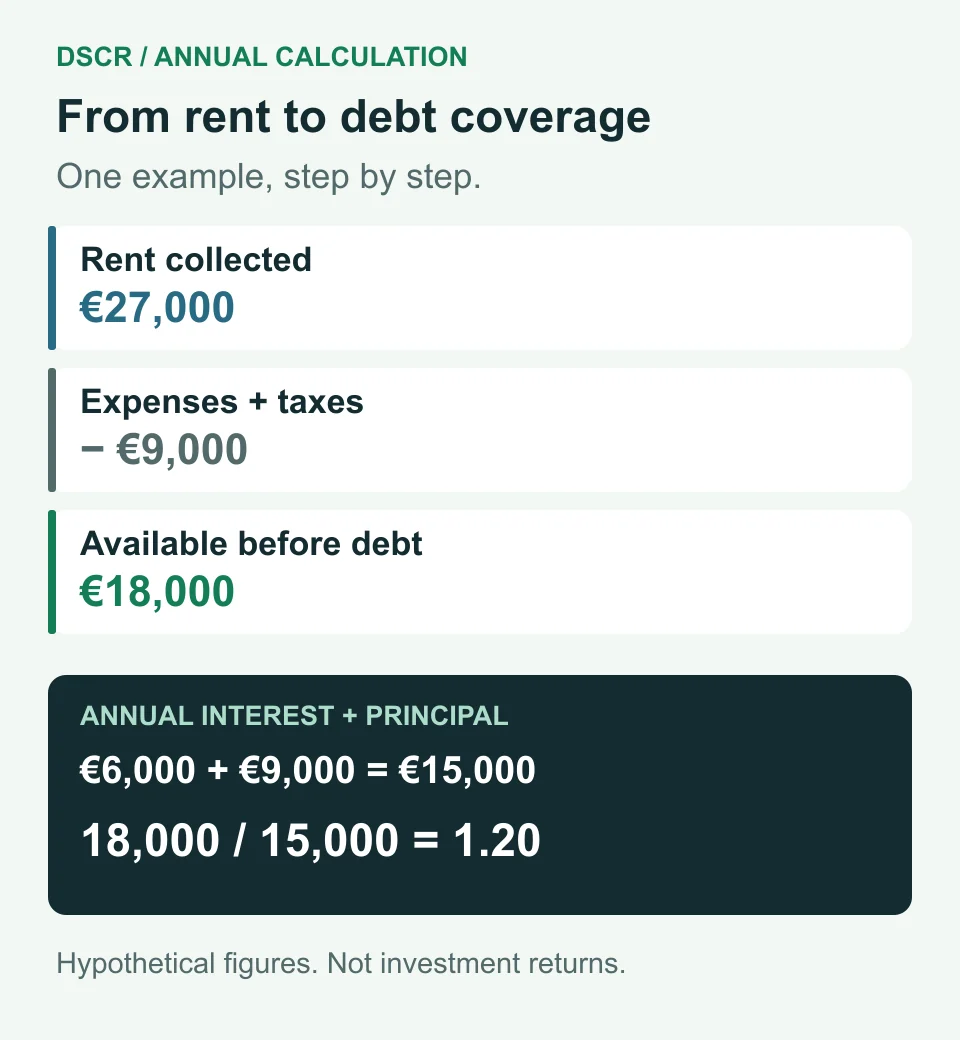
This article uses a simple cash basis: rent actually collected, less operating expenses and taxes paid during the period, before debt payments.
Do not automatically start with the maximum advertised rent. A vacant property or a non-paying tenant does not provide that cash. Also check who pays for maintenance, insurance, management and other expenses.
Documents may refer to net operating income, EBITDA or cash flow available for debt service. These amounts are not automatically interchangeable. Ask for the formula and check, in particular, how taxes, capital works, fees and cash reserves are treated. Positive accounting earnings can also include revenue that has not yet been collected.
Debt service
In the example below, this means the interest and principal contractually due during the year. Repaying loan principal uses cash, even though it is not a property's operating expense.
If you are assessing a project's capacity to pay all its creditors, include every relevant loan within that scope. A ratio covering only bank debt may exclude payments owed to other lenders.
Avoid counting an expense twice: if interest has already been deducted from the numerator, reconstruct the income base before dividing it by interest and principal due.
Example: calculate DSCR step by step
Imagine a rented property with one loan and the following movements over a year. All figures are hypothetical and do not represent a property, an offer or Dolux returns.
1. Move from potential rent to rent collected
- Potential rent with full occupancy and payment: €30,000.
- Rent not received because of vacancy or non-payment: €3,000.
- Rent actually collected: €27,000.
Do not deduct the €3,000 again if you start with the €27,000 already collected.
2. Deduct property expenses
- Operating expenses paid: €7,000.
- Property-related taxes paid: €2,000.
- Total expenses and taxes included: €9,000.
Income available before debt payments is €27,000 − €9,000 = €18,000.
The €2,000 is simply a cash assumption: it is not a tax rate or a calculation of Portuguese tax. For simplicity, we assume no extraordinary capital works, new mandatory reserves or charges beyond those identified. In a real case, such payments can affect repayment capacity and should be addressed explicitly.
3. Add interest and principal
- Interest due during the year: €6,000.
- Principal repayments due during the year: €9,000.
- Annual debt service: €15,000.
4. Divide comparable amounts
DSCR = €18,000 ÷ €15,000 = 1.20
After the included payments, €3,000 remains. This illustrative balance is not automatically profit available for distribution to investors: contractual restrictions or other cash needs outside this simplified model may apply.
How to interpret 0.80, 1.00 or 1.20
The formula's break-even point is 1.00:
- Below 1.00: the included income does not cover the included debt payments. Money from another source, an agreed reduction in payments or another solution will be needed; the ratio alone does not identify which.
- Exactly 1.00: coverage is exact, with no headroom under the assumptions used.
- Above 1.00: income exceeds debt service. You still need to assess whether that difference survives less favourable conditions.
A DSCR of 0.80 means €0.80 is available for each euro of debt service, leaving €0.20 uncovered. It does not, by itself, mean a 20% investor loss.
Nor should you treat 1.20 or 1.25 as a universal seal of safety. Any required contractual threshold, and the ratio's definition, need to be checked in each financing agreement. This article does not present a minimum applicable to every bank, platform or project.
Our example has €3,000 of headroom. A 16.7% fall in the €18,000 of available income, with debt service unchanged, would almost eliminate it. That percentage relates to income after expenses, not gross rent.
Three stress scenarios
A central forecast becomes more useful when compared with less favourable conditions. The EBA guidelines on loan origination and monitoring, section 5.2.7 include consideration of changes in rent, vacancy, expenses and refinancing in commercial real estate lending. These are banking supervisory guidelines; we use that reasoning as an analytical reference, without presenting it as a universal obligation for crowdfunding investors.
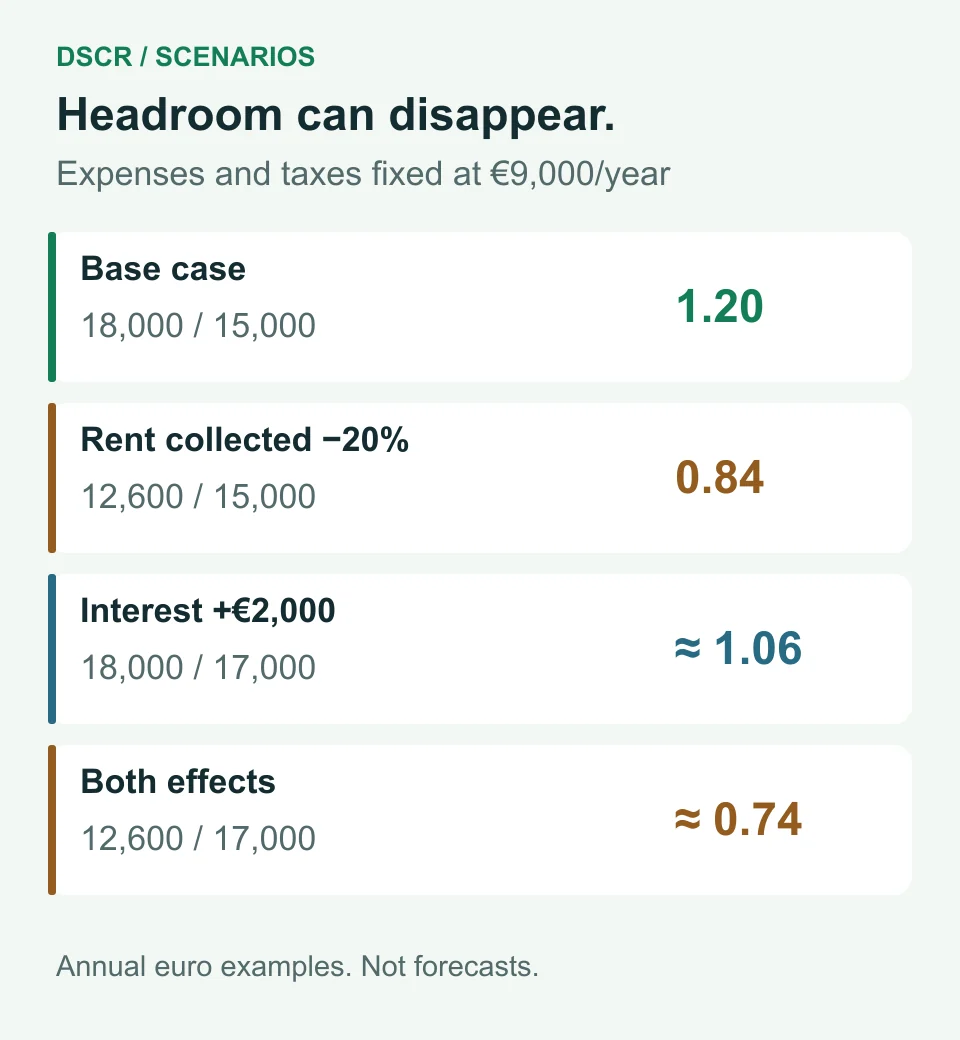
In the following scenarios, €9,000 of expenses and taxes remains constant solely to isolate the effects. We are not modelling an actual tax assessment or forecasting rents or interest rates.
Scenario A: 20% less rent collected
Collections fall from €27,000 to €21,600. After €9,000 of expenses, €12,600 remains to cover the same €15,000 of debt service.
DSCR = €12,600 ÷ €15,000 = 0.84
The year's shortfall is €2,400. Notice that a 20% drop in collections reduced available income by 30%: the expenses we held constant did not fall.
Scenario B: €2,000 more interest
Available income remains €18,000, but interest rises to €8,000. With €9,000 of principal repayments, debt service increases to €17,000.
DSCR = €18,000 ÷ €17,000 ≈ 1.06
Headroom falls to €1,000. The interest increase is a euro assumption, not an assumed rise in Euribor: a rate change's effect depends on outstanding principal and the loan terms.
Scenario C: both effects at once
With €12,600 available and €17,000 due, DSCR is approximately 0.74. The shortfall is €4,400.
No probabilities are assigned to these scenarios. They help identify which assumptions repayment capacity depends on.
DSCR, ICR and LTV answer different questions
ICR measures interest coverage. Using the same income base as our example, it would be €18,000 ÷ €6,000 = 3.00. That appears to provide ample coverage, but ignores €9,000 of principal repayments. Including those payments gives a DSCR of 1.20.
LTV compares debt with the property's value. It helps assess leverage against a valuation, but does not show whether enough rent is collected to meet this month's payments.
Do not use one ratio as a replacement for the others. An assessment of property investment in Portugal needs to distinguish asset value, cash generated and payment dates.
When principal is repaid only at maturity
With an interest-only loan that repays principal at maturity, known as a bullet loan, coverage of interim payments does not demonstrate how principal will be returned.
In a November 2025 supervisory note, the ECB highlights the risk of reaching maturity without being able to sell the asset or obtain alternative financing. The note concerns banking practices; it does not certify any investment or platform.
In such cases, request a separate maturity plan: the full amount due, the expected source of funds, the sale or refinancing timetable and the alternative if that exit fails. Also check whether the reported DSCR uses actual payments or hypothetical amortisation; those results are not directly comparable.
A construction project intended to sell completed properties may generate no rent during development. Applying this article's rental example without adjustment misses its main source of repayment. The budget through completion, cash requirements, expected net sales proceeds and the timing of receipts matter.
This distinction also helps explain sources of income in fractional real estate. Exposure to a project does not necessarily mean receiving rent, owning the property or ranking equally with another lender.
What to ask for before relying on the number
To reproduce the calculation, request:
- The complete formula, including expenses deducted and debt covered.
- The period and data date: actual results, budget or forecast.
- A breakdown of receipts and payments, with contracts and collections supporting material assumptions.
- The interest and principal schedule, including final maturity and any grace periods.
- Adverse scenarios and the source of funds needed to cover shortfalls.
Even an annual DSCR above 1 can conceal a monthly cash shortage: rent received later cannot pay an instalment due earlier. Cross-check the ratio against a cash timetable and reserves actually available.
If you are starting to invest from scratch, use this indicator to ask better questions, without turning it into a shortcut for deciding. Dolux is being built with a focus on access and understanding investment; you can follow the launch through the waitlist.
Frequently asked questions about real estate DSCR
Is DSCR an investment return percentage?
No. It compares available income with debt service. A DSCR of 1.20 indicates €1.20 of coverage per euro due under the formula used; it does not promise a 20% return.
Does a DSCR above 1 guarantee repayment?
No. The result depends on the data, assumptions and period. It may not reflect interim cash shortages, other debts or the principal due at final maturity.
What is the difference between DSCR and ICR?
ICR includes interest in the denominator. DSCR also includes principal repayments. Before comparing them, check that they use the same income base, period and scope.
Can I calculate DSCR using gross rent?
You can perform that division, but it does not represent the net coverage used in this article. You must account for uncollected rent and relevant expenses, avoiding duplicate deductions.
Does DSCR work for every real estate crowdfunding project?
Not in the same way. It is more informative where recurring cash flows can be compared with debt payments. If repayment depends on a final sale, that exit and cash requirements until then must also be assessed.
Sources and references
- ESRB — Recommendation ESRB/2019/3, Annex V, sections 6 and 7: LTV, ICR and DSCR bases.
- EBA — Guidelines on loan origination and monitoring, EBA/GL/2020/06, sections 5.2.7 and 5.2.8: income, adverse scenarios and property development lending.
- ECB — On-site insights: good practices for CRE bullet loan lenders, 20 November 2025: monitoring refinancing risk.
Sources checked on 5 October 2026. The calculations and scenarios are original educational examples, not market data.
Educational content, not personalised investment advice. Investing can involve partial or total loss of capital and difficulty exiting. Tax treatment and legal terms depend on individual circumstances; seek qualified professional advice when needed.