

Having money in twenty projects does not mean having twenty independent risks. If eight belong to the same developer group, difficulties within that group could affect a substantial part of your portfolio at once.
To diversify in real estate crowdfunding, start by identifying what your investments have in common. The number of projects is only one measure: who must repay you, where the money will come from and when you expect to receive it also matter.
Short answer
A useful assessment starts with five questions:
- How much of your overall financial wealth is in crowdfunding?
- How much capital depends on each project and developer group?
- Are locations, property types or repayment sources repeated?
- How much capital could become unavailable at the same time?
- Can you keep track of each investment's documents and developments?
Spreading capital can limit the impact of an isolated problem. It does not prevent losses when several investments are affected, or guarantee an early exit.
First, separate two decisions
Allocating wealth across investment types differs from allocating your crowdfunding portion across projects. The SEC's Investor.gov explains this distinction between asset classes and investments within each class.
Someone can spread all their money across many property loans and still depend on one sector, with limited liquidity. A home, a rental property or employment income linked to construction are also economic exposures to consider, although they are not cash available to invest.
Portugal's CMVM advises against placing emergency money in products that are difficult to redeem. Review your budget, goals and emergency reserve before selecting investments. Our guide to starting to invest from scratch helps organise that preparation.
No portfolio allocation percentage suits everyone. The examples below teach you to measure concentrations; they are not proposed investments.
Six exposures to examine beyond the project name
FINRA explains how correlated holdings and illiquid positions can create concentration. Applying that principle to real estate crowdfunding, the following map can help.
1. Project, borrower and developer group
Record the entity obliged to repay you and who controls it. Two separate project companies may rely on the same team, shareholder or financial support.
That connection does not automatically make the companies liable for each other's debts: rights depend on contracts and security arrangements. It is nevertheless a reason to aggregate group exposure as well as measuring it by company.
If you cannot confirm the connection between entities, flag the missing information. Do not classify an exposure as independent simply because the trading name differs.
2. Location and demand
Two properties in different municipalities can target the same type of buyer. In a hypothetical example, two higher-end housing developments in the same metropolitan area could depend on similar demand despite their different addresses.
Record location and market segment without assuming that moving to another city or country removes common risks. If you invest in another currency, also consider the effect of currency conversion.
3. Repayment source and project stage
Ask where the money needed to repay your principal is expected to come from: unit sales, rent, refinancing or another source identified in the documents.
A project awaiting permits, a construction site and an already rented property have different needs. Even so, several projects may depend on obtaining new credit at the same time. Identify that dependency without automatically treating one stage as safer.
4. Instrument and security
Lending to a company is not the same as purchasing part of a property. An equity stake in the company does not provide the same rights as a loan either. For an introduction, see fractional real estate investment.
Record the instrument, repayment priority and security actually documented. Several mortgage-backed investments are not necessarily independent: they may rely on the same market or even share collateral. Legal assessment of security and repayment priorities may require professional support.
5. Maturities and payment structure
Receiving interest during a contract does not mean your principal is being repaid. When principal is due at maturity, that exposure may remain until the end of the term.
Group expected principal repayments by quarter and consider a delay scenario. A contractual schedule sets out payments due; it does not guarantee the money will be available on those dates.
6. Platform and monitoring
Record where you monitor each investment, who provides the services and how you should receive information if there is an interruption. Spreading investments across platforms may change some operational dependencies, but the same developer can appear on more than one.
Your group totals should therefore include all platforms. Opening a second account does not, by itself, reduce exposure to a borrower.
Example: twenty projects, but 40% in one group
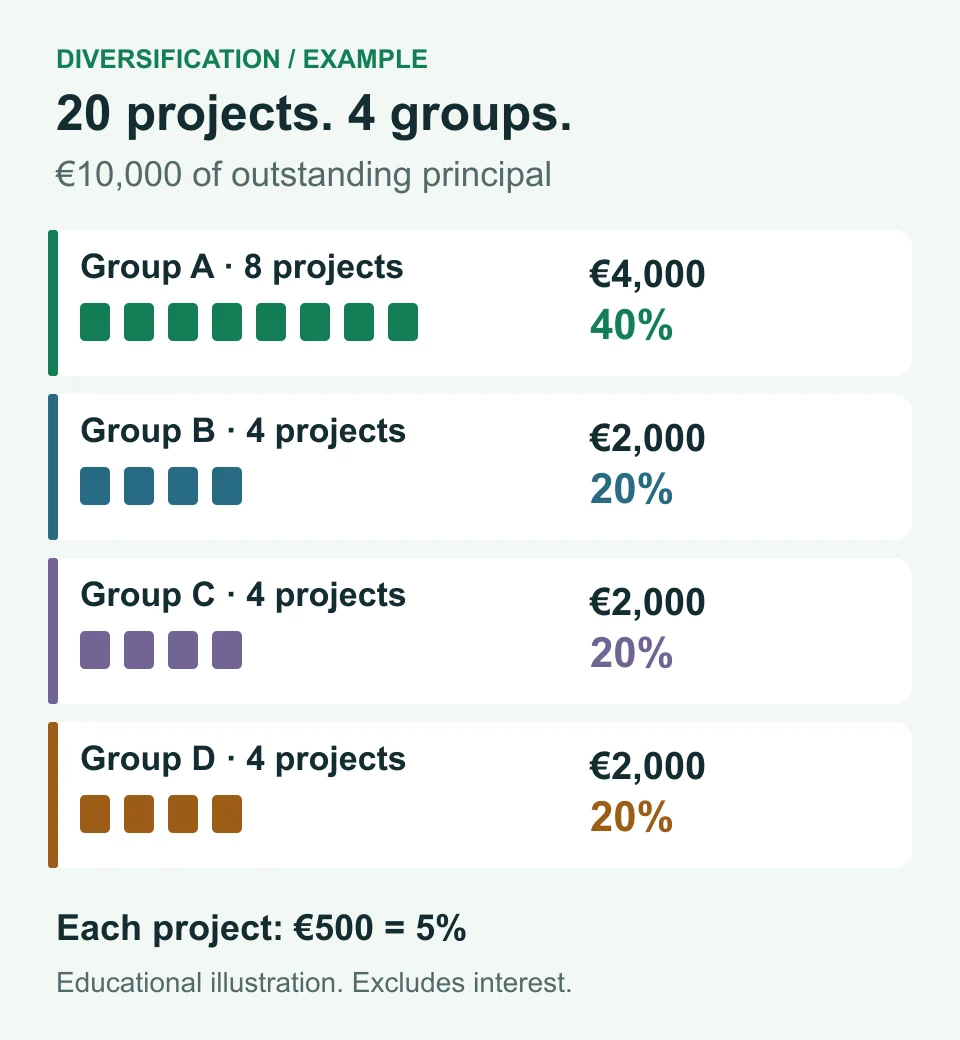
Imagine a crowdfunding allocation with €10,000 of outstanding principal, split equally across twenty loans of €500. Accrued interest is excluded from this calculation.
- Group A: eight projects, totalling €4,000.
- Group B: four projects, totalling €2,000.
- Group C: four projects, totalling €2,000.
- Group D: four projects, totalling €2,000.
Each project's weight is €500 ÷ €10,000 = 5%. Group A's weight is €4,000 ÷ €10,000 = 40%. These weights describe this allocation alone, not the person's overall wealth.
Now compare two purely illustrative scenarios in which half the principal of the affected investments is lost:
- One project affected: €500 × 50% = a €250 loss, equal to 2.5% of the initial €10,000.
- All eight group A projects affected: €4,000 × 50% = a €2,000 loss, equal to 20% of the initial €10,000.
These calculations do not estimate default probability or recovery in a real case. They assume no losses on the remaining principal and exclude interest, taxes, costs and recovery time. A loss can exceed the example, including the entire investment.
The useful question is: if this dependency fails, how much capital could be affected together?
Always use a consistent measurement basis
For loans, one simple monitoring measure is:
Group weight = outstanding principal in its projects ÷ outstanding principal in all loans being assessed × 100.
Use values from the same date and in the same currency. Avoid mixing original investment amounts with balances already partly repaid. Record interest and other amounts separately so you know what the calculation includes.
Outstanding principal measures contractual exposure, not a sale price or recoverable amount. A troubled loan does not become safe because its displayed balance is unchanged. Equity holdings need their own monitoring basis; do not mix them with loans as if the balances were equivalent.
You can repeat the calculation by region, repayment source or maturity. These classifications overlap: one loan can belong to group A, be located in Lisbon and mature in a particular quarter. Do not add those category percentages together to produce a supposed total risk.
A delay can change your portfolio without a new investment
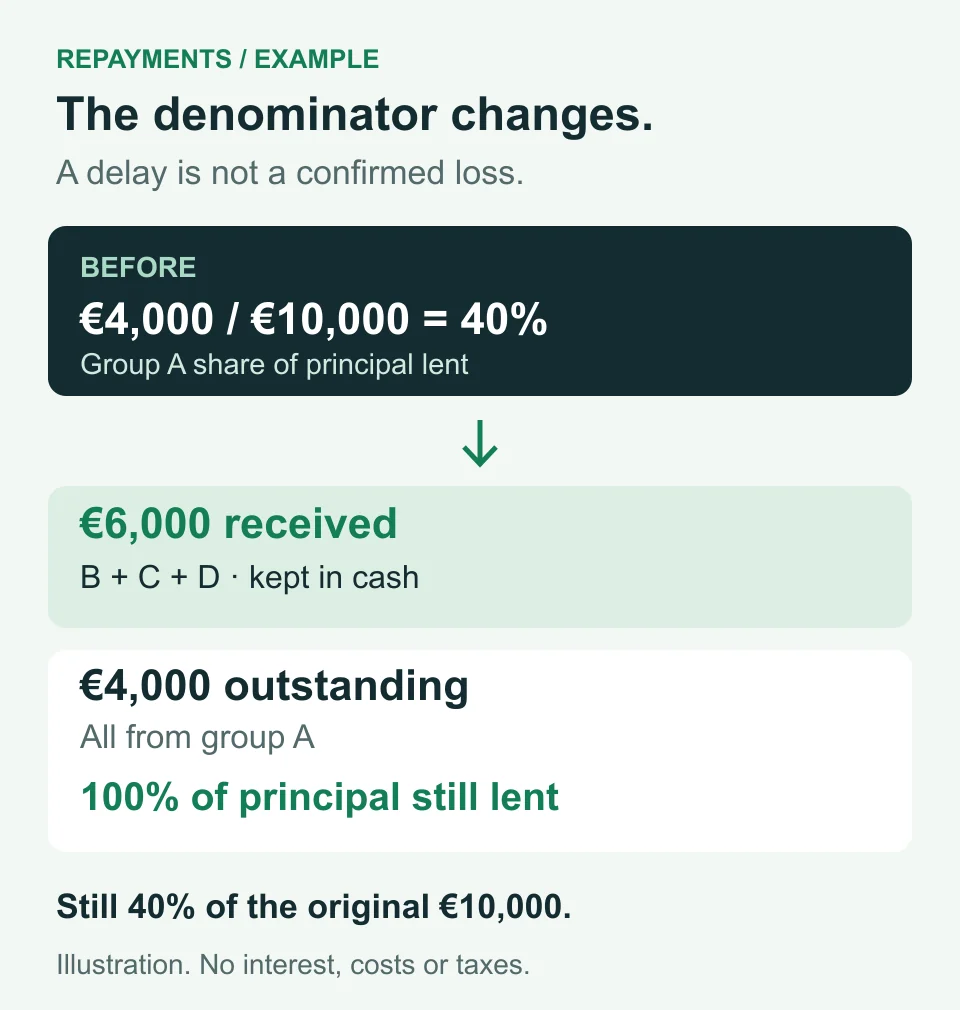
Return to the €10,000 example. Groups B, C and D repay their €6,000 in full. Group A delays repayment of its €4,000. To keep things simple, we continue to exclude interest, costs and taxes.
If you keep the €6,000 received in cash, the allocation initially assessed now consists of:
- €6,000 received, outside the loans;
- €4,000 outstanding, all from group A.
Group A now represents 100% of principal still lent, but remains 40% of the original €10,000. The percentage changes because the denominator changes. This does not mean a 40% loss has occurred, or that all the person's wealth is concentrated in that group.
A delay does not prove there will be no loss either: the amount and timing of recovery remain uncertain. Review concentration after repayments, extensions and material changes, as well as before investing.
Applying these criteria with limited capital
A low minimum investment can make splitting capital easier, but it does not create suitable or independent projects. If your budget allows only a few investments, recognise that concentration rather than increasing your total allocation just to reach a project count.
Before adding a position, compare group weight before and after. If you already hold €4,000 in group A out of €10,000 and add another €500 to that group, exposure becomes €4,500 ÷ €10,500, or approximately 42.9%. Adding a project increased concentration in the group.
You may also find a different project you do not understand or whose documentation is insufficient. Diversification is not a reason to accept it. Our guide to investing in real estate with little money covers access routes; here, the aim is to understand what risk each new position adds.
Reducing concentration in an illiquid portfolio may take time. Do not rely on an immediate sale to adjust the allocation or use your emergency reserve to dilute percentages. Article 23 of Regulation (EU) 2020/1503 provides for a warning about capital loss and the possibility of being unable to sell when you wish.
A practical portfolio review checklist
In a spreadsheet, create one row per investment and record:
- project, borrower and identified developer group;
- platform and property location;
- instrument, security and documented priority;
- outstanding principal and currency;
- expected repayment source and project stage;
- next principal payment, maturity and any delay;
- date of the latest information and links to documents.
Then write down the answers: which is the largest group, what are the main common dependencies and how much capital would be unavailable if the nearest maturities were delayed? Clearly separate confirmed information, assumptions and what you do not yet know.
This review complements individual project analysis. It does not replace it or turn the number of investments into a promise of safety.
Frequently asked questions about crowdfunding diversification
How many projects are enough to diversify?
The number alone cannot answer that question. Twenty projects from the same group or relying on the same kind of sale can remain heavily concentrated. Examine weights and common dependencies as well as quantity.
Does using several platforms solve concentration?
It can spread some operational dependencies, but does not eliminate exposure to the same developer, sector or market. Add investments across all platforms before calculating each group's weight.
Is splitting money equally enough?
It equalises initial project weights, not group weights or risk quality. It also stops producing equal weights when partial repayments, losses or delays differ.
If every project has security, do I still need diversification?
Yes, concentrations still need assessment. Separate security arrangements can depend on the same market; enforcement, priority and actual recovery require analysis. Security does not guarantee full or timely repayment.
Should a delay be counted as a total loss?
Not automatically. Distinguish outstanding principal, unavailable cash and a possible loss. Keep the delay visible in your monitoring and update scenarios as information arrives, without assuming full recovery.
Sources and references
Accessed on 28 September 2026:
- CMVM, Recommendations for investors, pages 3 and 17: emergency reserves and diversification. A 2012 publication used only for these financial literacy principles.
- SEC / Investor.gov, Asset Allocation and Diversification: diversification across and within asset classes.
- FINRA, Concentrate on Concentration Risk: common dependencies and concentration in illiquid investments. General principles, not Portuguese legal rules.
- Regulation (EU) 2020/1503, Article 23(6)(c): risk warning applicable to the key investment information sheet.
The examples, calculations and monitoring checklist are educational illustrations by the Dolux Team, not data from real projects or portfolios. This content is not personalised investment advice. You may lose some or all of your capital; income and liquidity are not guaranteed.
Dolux is being built with a focus on clarity and financial literacy. To follow its development, you can join the waiting list.