
The date for receiving your capital arrives, but the payment does not. The platform still labels the project as “being monitored”. Your first question is straightforward: is this a temporary problem, or might you fail to recover your money?
The status displayed in an app cannot answer that on its own. You need to establish what is due, who owes it, what rights you hold and which steps are actually being taken. This guide addresses default in loan-based real estate crowdfunding, from the perspective of an investor in Portugal. References to the European framework apply to offers covered by Regulation (EU) 2020/1503.
Short answer
A missed payment may lead to requests for information, negotiation of new terms or recovery measures. The outcome can be full repayment, partial recovery or total loss. There is no universal deadline for recovering capital.
- A delay describes a payment that has not arrived when due; check the applicable contractual schedule.
- Default requires looking at the contract and, for platform statistics, the regulatory definition used.
- A final loss differs from money still being pursued: while recovery remains open, the outcome may be uncertain.
An authorised platform, a property or a security interest does not guarantee repayment. This article does not describe a Dolux project or incident.
Are a delay and a default the same thing?
Not necessarily. A payment that is a few days late does not, by itself, establish the final loss. Equally, you should not assume an investment is performing normally just because the word default has not appeared.
For calculating default rates on crowdfunding loans, Article 1 of Commission Delegated Regulation (EU) 2022/2115 identifies two alternative conditions: payment in full is considered unlikely without measures such as enforcing security, or a material credit obligation is more than 90 days past due. The provider must disclose the materiality threshold used.
This statistical criterion does not grant permission to pay 90 days late. A problem may be identified earlier, and your rights also depend on the contract and applicable law. Do not wait for that count before asking about a missed payment.
The same regulation requires investors to be informed without delay when a loan defaults. Still, distinguish the classification from the outcome: a defaulted loan does not necessarily have zero recovery.
What if the repayment date was extended?
Request the clause or document supporting the change, the new date and its financial explanation. An updated sales forecast does not, by itself, validly amend the contract.
Under the European methodology, changes expressly permitted by the contract can alter the schedule used to count days past due. However, the provider must still assess whether payment is unlikely. A restructuring granted because of financial difficulties can indicate deterioration even when the calendar displays a new date.
Do not treat an extension as automatically good or bad. Assess whether it offers a credible, funded solution or simply postpones the same unresolved problem.
Who owes you money, and who handles recovery?
For a loan, first identify the contractual borrower. Then check who administers payments, represents investors and has authority to negotiate or enforce security. Different entities may perform these functions.
Do not automatically assume the platform must repay the loan from its own funds. A duty to provide services or monitor a project is not equivalent to a capital guarantee. Any personal or contractual guarantee must be read on its own terms, including limits and conditions.
If you hold equity rather than a loan, the analysis changes: you do not necessarily have the same right to repayment on a fixed date. Our guide to fractional real estate investment explains the models; each transaction's documentation determines the actual rights.
What can happen after a payment is missed?
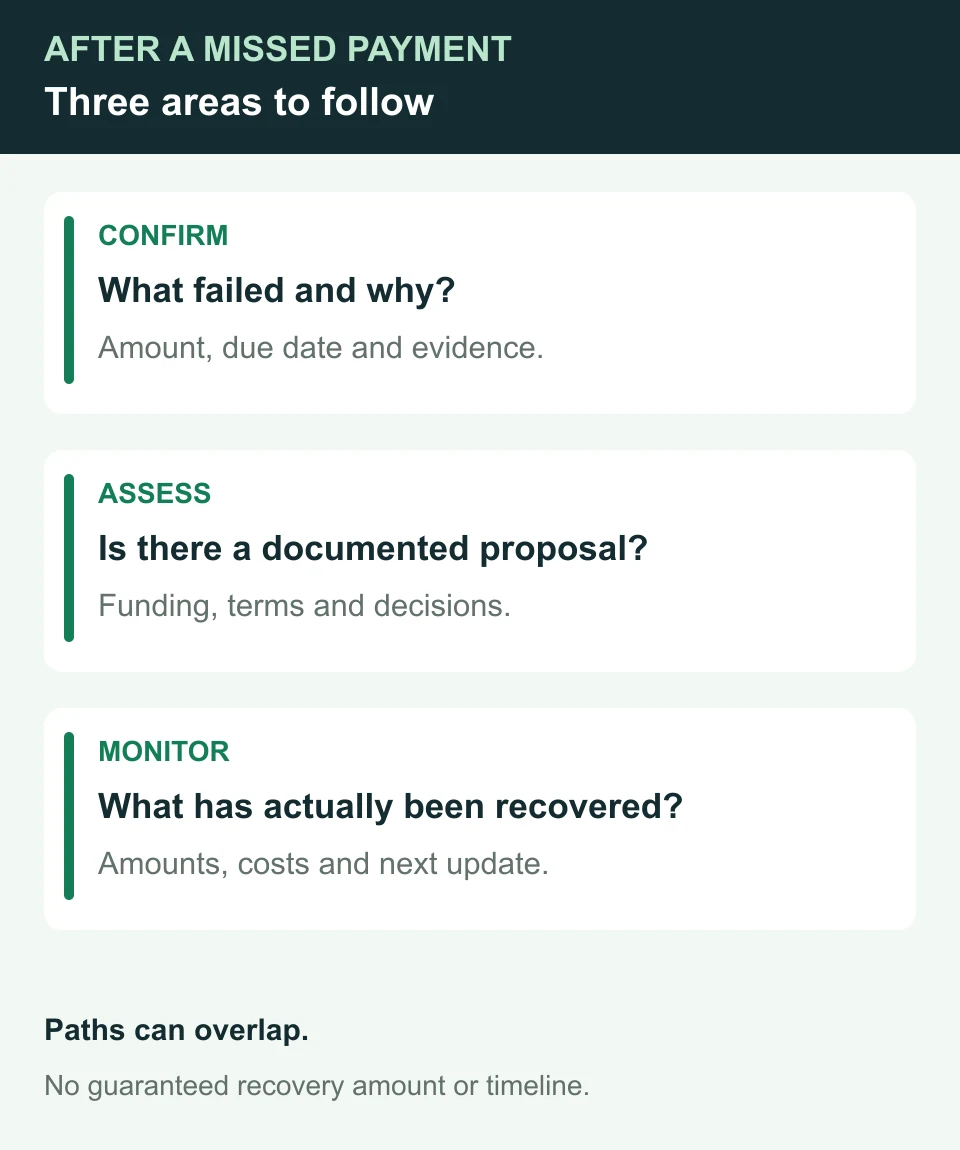
The following paths may overlap. They are neither a mandatory sequence nor a court timetable.
1. Confirm the missing payment and establish the cause
Distinguish a processing problem from a lack of funds in the project. Request the overdue amount, due date, identified cause and next update. If the explanation is that “the sale is almost complete”, ask which condition remains outstanding and what evidence supports the forecast.
A useful explanation connects a cause with a verifiable action. “Completion depends on a particular document” is more specific than “the market is difficult”, but it still requires a timetable and follow-up.
2. Assess a proposal to regularise or restructure the loan
A proposal may involve more time, different instalments, new capital or a reduction of amounts owed. Before assessing it, establish:
- where the money will come from, and whether it is merely forecast or already committed;
- who decides on the change, including voting or consent rights;
- what changes to principal, interest, costs and security;
- whether a new creditor will enter and with what priority;
- what happens if the revised plan fails.
A newly advertised interest rate does not, by itself, resolve an inability to pay. Interest accumulating on paper is not cash received.
3. Pursue recovery of outstanding amounts
Depending on the contracts, security and jurisdiction, options may include negotiated collection, court proceedings, enforcement of security or insolvency mechanisms. The word “mortgage” alone does not establish the appropriate route.
Ask who is acting, what authority they hold, the expected expenses and the amounts actually recovered. The original property valuation is not the same as an achieved sale price. Other creditors and costs can reduce the amount available for your investment.
Decisions on restructurings, voting, enforcement or filing claims may require independent legal advice. Specific deadlines may apply; a general blog explanation cannot replace them.
Recovering part of the money: how to calculate the result
Separate capital invested, amounts received and expenses borne. A gross recovery percentage can give a different impression from the money you actually retain.
Consider this hypothetical example, with no earlier payments:
- principal originally lent: €1,000;
- recovered amount allocated to your investment: €650;
- recovery costs charged to you and deducted from that amount: €50;
- cash received after those costs: €600.
€650 − €50 = €600 received
€1,000 − €600 = €400 capital loss, or 40%
Gross recovery was 65%; recovery after the assumed costs was 60%. The €50 is not a typical fee, a statutory charge or a Dolux fee. It is simply an assumption used in this calculation.
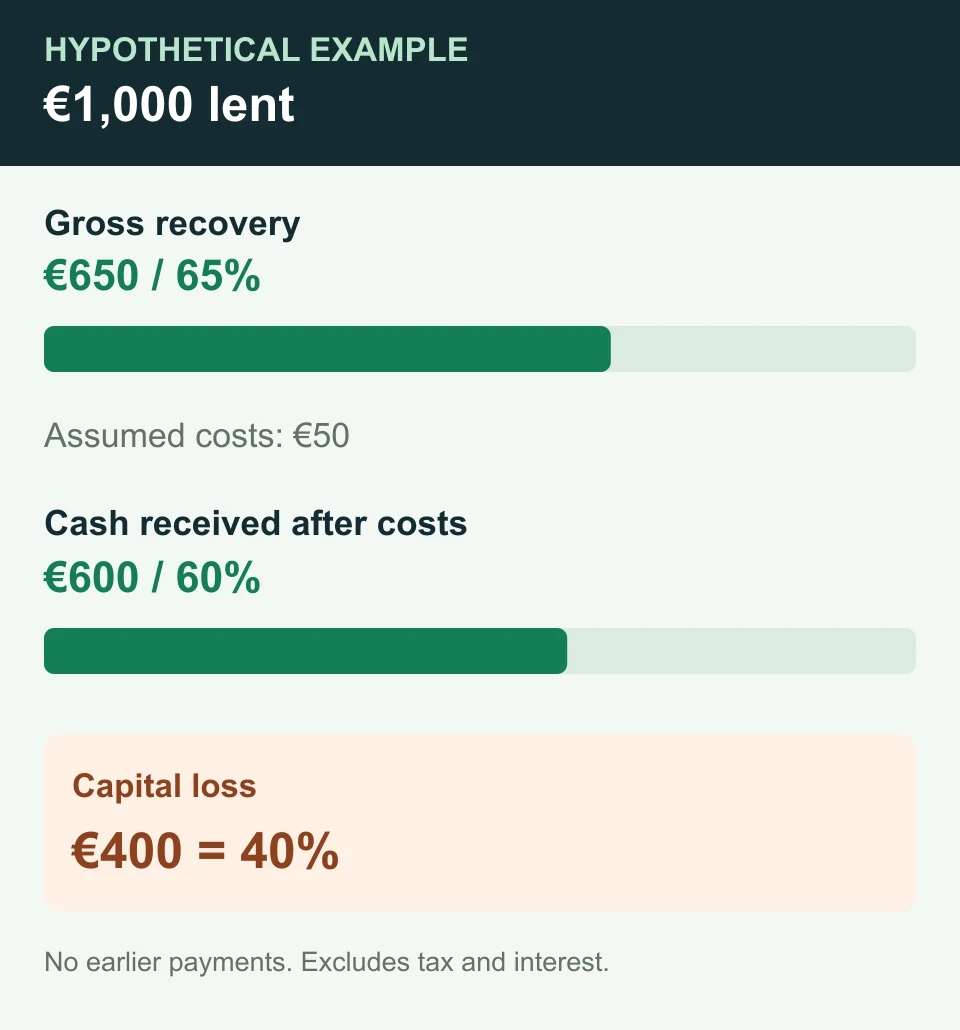
This example excludes tax, interest and other cash flows. It is not an annual rate of return. If you previously received interest or principal repayments, gather every transaction and its date before calculating the overall result.
Even receiving the full €1,000 long after the scheduled date can cause a liquidity problem. Full principal repayment does not mean timely repayment or the expected return. While recovery is ongoing, distinguish money already received from amounts you still hope to receive.
What if the platform itself stops operating?
Borrower failure and platform failure are different risks. A project may retain its payment obligations even when the service used to monitor it is interrupted.
Article 12(2)(j) of Regulation (EU) 2020/1503 requires a continuity plan for critical services relating to existing investments. Having a plan does not guarantee uninterrupted service or payment by the borrower.
Before you need it, identify the alternative contact, who holds the records, who will service the loans and how any changes will be communicated. Keep copies of documents and statements outside the app.
Also distinguish protection of money that may be held with a payment service provider from protection against a loan loss. For offers covered by the European framework, the Article 23 risk warning states that the investment is not covered by the deposit guarantee or investor compensation schemes specified there.
What to request from the platform in writing
Instead of several vague messages, organise a request around these questions:
- What amount is overdue? Separate principal, interest and other charges, with dates.
- What is the loan's status? Identify the classification, date and criterion used.
- What is the documented cause? Distinguish confirmed facts from the developer's forecasts.
- Who is taking action? Identify the people responsible for monitoring and recovery.
- Is there a concrete proposal? Explain amendments, decisions required and supporting documents.
- What costs may investors bear? Identify the contractual basis and how they will be charged.
- What has already been recovered? Separate cash available, cash distributed and estimated proceeds.
- When will the next update arrive? Request a date, even if a final solution is not yet available.
Keep the contract, key investment information sheet, payment records, original schedule, amendments and responses. This record helps you monitor the case and substantiate a complaint.
How to complain without confusing a complaint with repayment
Start with the provider's published formal procedure. For offers and services covered by the European framework, Article 7 provides for complaints to be submitted free of charge.
Commission Delegated Regulation (EU) 2022/2117 requires acknowledgment and information about admissibility within 10 working days. This is not a promise of a final decision or repayment within that period. The final response follows the timeframe specified in the procedure, with rules on exceptional delays and reasons for decisions.
Describe the facts, attach documents and explain what you want clarified or challenged. If the response is insufficient, identify the competent authority and remedies applicable to the provider and transaction. In Portugal, the CMVM investor support service receives information requests and complaints.
A complaint about the provider's information or conduct is not equivalent to collecting a loan. Decisions concerning financial rights, procedural deadlines or settlement proposals may require your own legal advice.
What to learn before the next investment
Read the recovery policy before investing and look for information on delays, defaults, costs and recovered amounts. Article 20 of the European regulation requires default-rate disclosure by providers facilitating loans. Check the period, methodology and meaning of the indicator: a default rate is not a capital-loss rate.
Do not substitute a project count for concentration analysis. Several loans may depend on the same developer or repayment source. Keep money needed in the near future independent of a project's sale. Our guide to starting to invest from scratch covers that preparation.
How Dolux works describes the model under development. You can follow the project through the waitlist. This educational content does not announce an available investment or a recovery service already under contract.
Frequently asked questions about crowdfunding default
Does a delay mean I have lost all my money?
It does not establish that. Payments may resume or money may be recovered later, but partial or total loss is also possible. Request information about the cause, rights and measures under way. Do not treat estimated recovery as cash received.
Must I wait 90 days before asking for information?
No. The more-than-90-days criterion forms part of the European default-rate methodology and does not itself change the contractual due date. Unlikeliness to pay may justify default classification earlier.
Does the platform have to return my capital?
Do not assume so. Identify the loan's borrower and each entity's actual obligations. Responsibility for providing a service and a possible payment guarantee are distinct matters.
Is there a fixed deadline to recover my investment?
There is no universal deadline. Duration depends on financial circumstances, contracts, security, negotiations and applicable proceedings. An updated forecast must be treated as a forecast, not a certainty.
Does a complaint require payment within 10 working days?
No. Under the European framework discussed here, those 10 working days concern acknowledgment and information about admissibility. They are not a deadline for recovering principal.
Sources and references
Checked on 14 September 2026:
- Regulation (EU) 2020/1503: Articles 7, 12, 20 and 23.
- Commission Delegated Regulation (EU) 2022/2115: Article 1, default criteria, schedule changes and investor notification.
- Commission Delegated Regulation (EU) 2022/2117: Articles 3 and 5, complaint admissibility and decisions.
- gov.pt: CMVM investor information requests and complaints.
General information, not a personalised recommendation or legal opinion. Investing can involve partial or total capital loss and illiquidity. Examples are hypothetical; contracts, jurisdiction and individual circumstances can change applicable rights and procedures.